
Chippewa County Court Records After Arrest
Chippewa County court records after a jail arrest follow a sequence. A person is arrested and booked at Chippewa County Jail. The roster may show a statute, an offense label, a warrant status, a DOC hold, or a court-pending note. Then the Chippewa County Attorney reviews the law enforcement reports and decides what to file in Minnesota District Court. Once a complaint, citation-based case, or other charging document is filed, the case becomes a court record.
The court record is different from the booking record. The jail side answers custody questions, intake date, booking number, and bond fields. The court side answers formal charge questions, hearing dates, dispositions, and orders. For current custody and booking details, use Chippewa County jail inmate records. For public booking photos, use the Chippewa County jail mugshots resource.
The county court contact screenshot comes from the Minnesota Judicial Branch Chippewa County District Court page, the official local court page for address, phone, hours, parking, and administrator details.
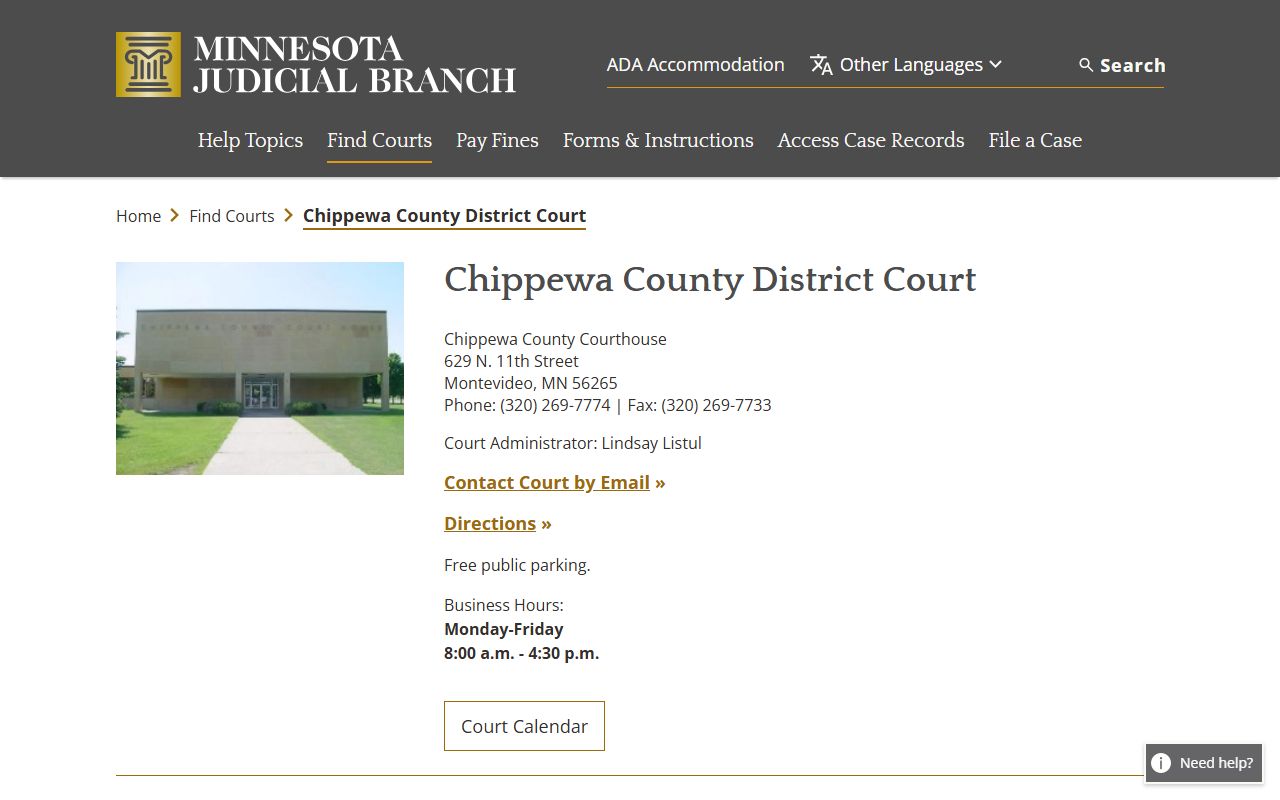
That official court page is useful when an online case search needs to be checked against the court counter, the daily calendar, or local court administration.
Court Records After Chippewa Arrest
The arrest-to-court pathway in Chippewa County is local at first, then statewide. A booking happens at Chippewa County Jail. The prosecutor reviews the matter. The criminal case opens in Minnesota District Court if charges are filed. After that, Minnesota Court Records Online, called MCRO, is the main public case-search tool for formal records.
- Arrest or warrant service leads to booking at Chippewa County Jail.
- The jail roster may show arrest or holding charges, but those are not always final filed charges.
- The Chippewa County Attorney reviews reports and decides which charges to file.
- A complaint, citation case, or other charging document opens the district court case.
- First appearance, bail hearing, pretrial, settlement, revocation, or other hearings are scheduled by court.
- The case becomes searchable in MCRO by name, case number, citation number, or attorney.
The daily court calendar is separate from case search. It can show upcoming events, but it is not a substitute for the register of actions or public documents in MCRO. A calendar entry may also change, so court staff should confirm current hearing settings when timing matters.
Search Chippewa County Court Records
Minnesota Court Records Online Case Search is the public portal for criminal court records after a jail arrest in Chippewa County. The MCRO overview says users can search by person name, business name, attorney name, case number, citation number, or attorney bar number. It also describes Document Search, Hearing Search, and Judgment Search paths. Access depends on the terms of use and on whether a document is public online.
| Field Label | Type | Required | Options / Format Notes |
|---|---|---|---|
| Search option | Tab or menu | Yes | Name, case number, citation number, or attorney search. |
| Person or business name | Text | Depends on selected search | Used for defendant name searches. |
| Case number | Text | Depends on selected search | Chippewa criminal cases commonly use a 12-CR-year-number format. |
| Citation number | Text | Depends on selected search | Useful for traffic and citation-based criminal matters. |
| Attorney name or bar number | Text | Depends on selected search | Used for attorney-linked searches. |
| Buttons | Button | N/A | The case search path provides search controls and terms. |
The MCRO screenshot comes from the Minnesota Court Records Online Case Search interface, where Chippewa County court records after an arrest can be searched once a case exists.
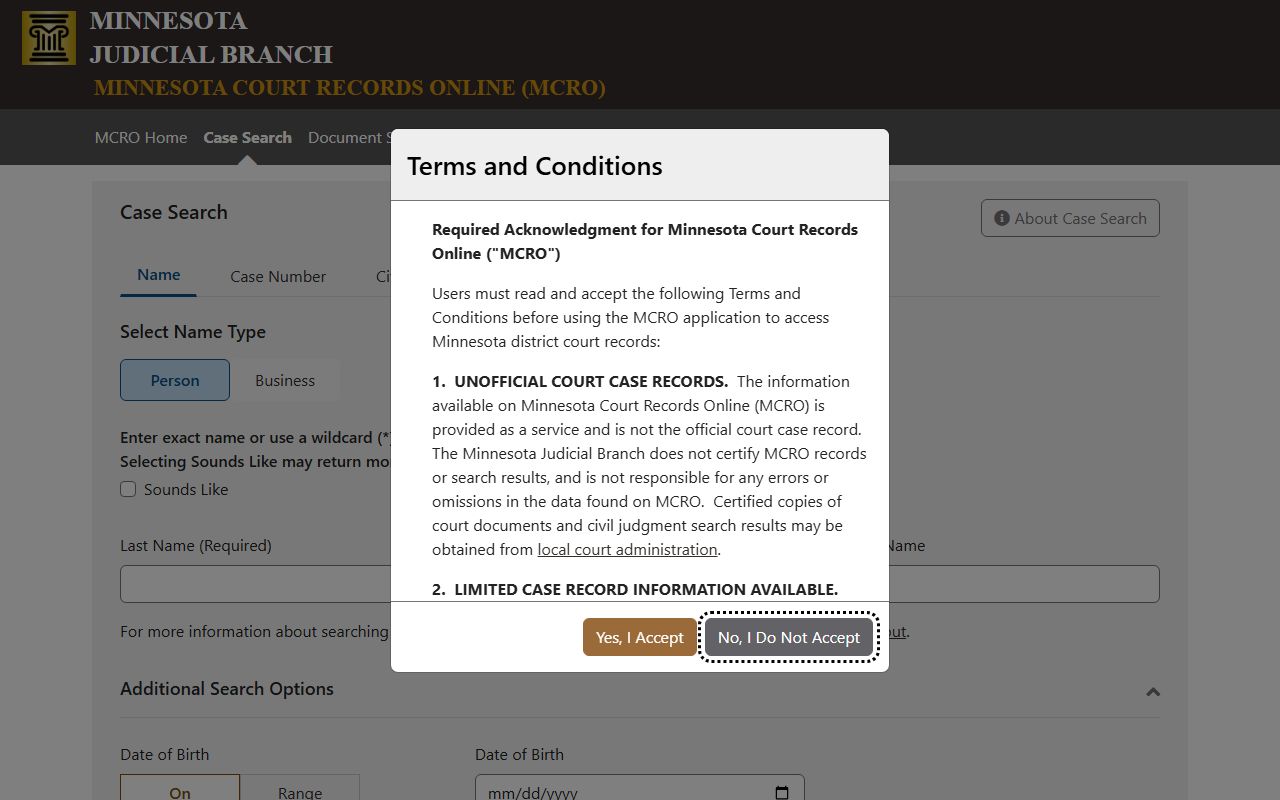
The image shows why a case number, citation number, or exact name can matter. The jail roster may help supply a name and charge context, but the court portal controls the formal case record.
Charges Filed After Arrest
The formal court record begins with a charging document or citation-based case. In Minnesota, the local prosecutor for Chippewa County is the Chippewa County Attorney. The official directory lists Matthew Haugen as County Attorney, and the county attorney's office is the local prosecution office for county-level criminal cases. Jail roster charges can be amended, narrowed, expanded, dismissed, or replaced when the filed case moves forward.
| Document | Who Uses It | What It Does |
|---|---|---|
| Complaint | Prosecutor | Common Minnesota charging document that states the alleged offense and supporting basis. |
| Information | Prosecutor | A formal charging document used in some criminal procedure settings. |
| Indictment | Grand jury | A charging document tied to grand jury action, generally for more serious matters. |
The research specifically tied the Chippewa County pathway to prosecutor review, filed charges, first appearance, and MCRO case access. It did not identify a separate local database for charging documents outside Minnesota Judicial Branch systems.
Chippewa County Charge Status
Charge status is one reason court records after a jail arrest should be checked separately from the jail roster. A roster entry can show COURT/PENDING, WARRANT, DOC HOLD, or SENTENCED. The court record may later show that a count was amended, dismissed, resolved by plea, set for trial, or sentenced. A charge is an accusation. It is not the same as a conviction.
| Status | What It Means |
|---|---|
| Court pending | The matter has not reached final disposition. |
| Warrant | A court order is tied to arrest or custody, often after failure to appear or a violation. |
| DOC hold | Custody is connected to Minnesota Department of Corrections authority. |
| Sentenced | Custody follows a judgment or sentence rather than only pretrial detention. |
| Dismissed | A count or case has been dropped by court action. |
| Amended | The filed charge has changed from its prior form. |
For formal status, use MCRO or contact Chippewa County District Court. For immediate custody status, call the Chippewa County Sheriff's Office instead of relying only on a court status label.
Bond Hearings After Arrest
Bond connects the roster and the court file. The Chippewa County roster displays amount, conditional amount, bail received, and bond received fields. The court case can show hearings and orders that explain release terms. The daily calendar has shown criminal hearing types such as bail hearing, pretrial, contested revocation hearing, and settlement conference.
A dollar figure on the roster does not prove release is available. DOC holds, warrants, court conditions, other-agency holds, or a pending first appearance can control the outcome. Minnesota's maximum cash bail statute sets ceiling rules for many misdemeanor and gross-misdemeanor offenses, but the case-specific order is still the key record.
| Release Term | How to Read It |
|---|---|
| Cash bail | Money paid under court terms to secure release and future court appearance. |
| Conditional bail | A lower amount paired with court rules, such as no-contact or sobriety terms. |
| No-bond hold | A hold where payment alone does not release the person. |
| Warrant bond | An amount tied to a warrant that may still require court action. |
Warrants and Court Records
The sheriff-linked active warrant listing is separate from MCRO and from the in-custody roster. The warrant table fields include warrant number, name, date of birth, date of warrant, bond or bail amount, offense level, and description. No search box or filter was visible in the captured warrant page, so the table is scanned or searched with browser find.
A warrant may lead to a Chippewa County jail arrest and then to court records after that arrest. The custody list may show a WARRANT status. The court record may show the underlying case, failure to appear, bail event, or later disposition. Minnesota law also treats some warrant-index data as confidential until the person is taken into custody, served, or appears, unless the agency decides public access serves the public purpose. Chippewa County publishes an official active warrant list, so use that source rather than third-party warrant pages.
Charges Versus Convictions
Court records after an arrest can show charges even when there is no conviction. That distinction is central to reading Chippewa County criminal cases. An arrest is the start of custody. A charge is a formal accusation. A conviction comes later, if there is a guilty plea, verdict, or other judgment that resolves guilt.
| Record Point | Charge | Conviction |
|---|---|---|
| Stage | Filed accusation after arrest or citation. | Final finding or plea accepted by court. |
| Meaning | The prosecutor alleges an offense. | The case has resulted in guilt on that count. |
| May Change? | Yes, charges can be amended or dismissed. | Changes require later court action. |
| Best Source | MCRO case record and filed documents. | MCRO disposition, sentence, and judgment entries. |
Do not treat a Chippewa County jail roster charge as proof of conviction. The roster is a custody record. The court file is the place to verify whether a count was filed, changed, dismissed, or resolved.
Sealed and Expunged Records
Minnesota access rules affect what appears in court and jail-related records. Minnesota Government Data Practices Act Chapter 13 governs state and local government data. Minn. Stat. 13.82 covers law enforcement data, including booking photographs and warrant-index rules. Minn. Stat. 13.85 covers corrections and detention data.
| Record Limit | Sealed | Expunged |
|---|---|---|
| Public visibility | Hidden from ordinary public access by court order or rule. | Sealed through an expungement process when legal requirements are met. |
| Agency access | Some justice agencies may still have access. | Access depends on the scope and terms of the expungement order. |
| Where to verify | District Court or MCRO access rules. | District Court order and Minnesota court records. |
Juvenile matters, sealed charges, some dismissed matters, private corrections data, and active-investigation material may not appear the same way as adult public criminal cases. A missing online record does not always mean no arrest or court event occurred.
Chippewa County Court Contacts
Chippewa County District Court is in the Eighth Judicial District. The court page lists the courthouse at 629 N. 11th Street, Montevideo, MN 56265, phone 320-269-7774, fax 320-269-7733, Court Administrator Lindsay Listul, business hours Monday-Friday from 8:00 a.m. to 4:30 p.m., and free public parking. The daily court calendar is published by the Minnesota Judicial Branch.
Chippewa County District Court
629 N. 11th Street
Montevideo, MN 56265
320-269-7774
Monday-Friday, 8:00 a.m.-4:30 p.m.
Chippewa County Attorney
County Attorney Matthew Haugen
Chippewa County, Minnesota
320-269-7138
Prosecutor for county-level criminal charges
For custody and bond confirmation, the sheriff remains the correct contact. For filed court records after a jail arrest, District Court and MCRO are the direct sources.